
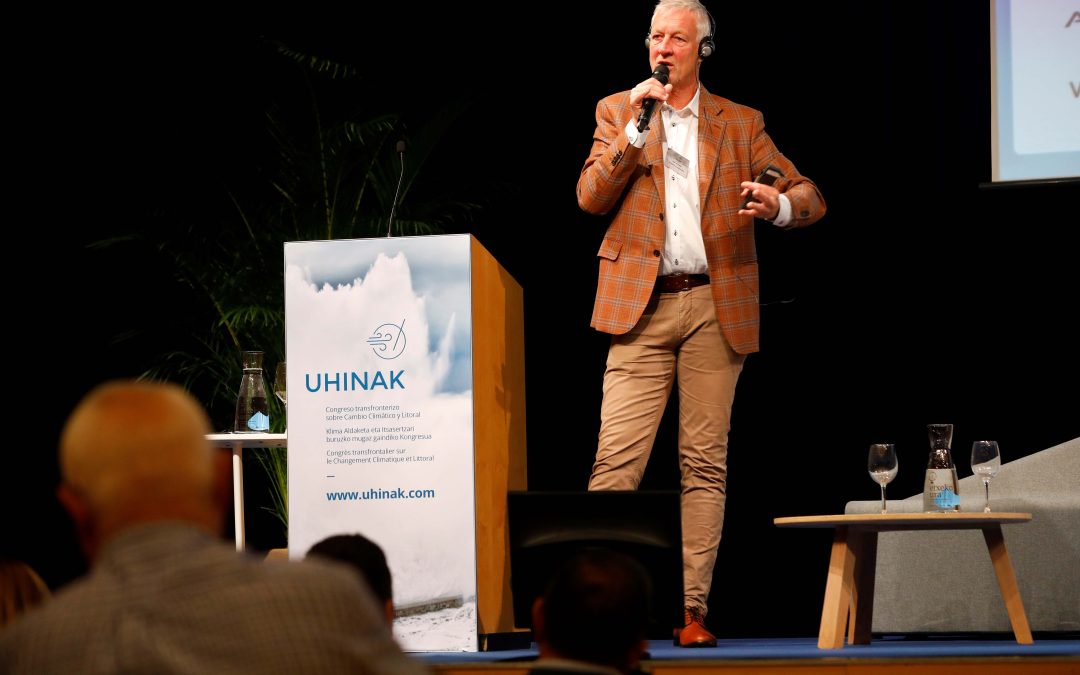
- Over two days, a full content of 8 guest talks, 35 oral presentations and 17 posters was seen by 160 participants at the Cross-Border Congress on Climate and Coastal Change held at Ficoba
The sixth Uhinak Congress, held on October 23 and 24 at Ficoba, attracted marine, coast and climate change experts together with scientists, actors and users, generating productive cross-border debate and information exchange in a cross-border context. The effect of climate change on the coast and the solutions for mitigating, anticipating and adapting to future scenarios were specifically addressed in over 50 presentations.
One relevant aspect debated was climate boundaries in the oceans and along Spain’s coast. Professor Peter Ditlevsen of the Niels Bohr Institute in Copenhagen spoke about the Atlantic meridional overturning circulation, an important turnaround event for the climate system, whose future collapse would have a massive impact on the climate in the North Atlantic region, with major uncertainties. Recent studies have shown that this circulation is weakening, and predictions point to a possible collapse halfway through this century if the current trend in greenhouse gas emissions continues.
Extreme events such as heatwaves or wave surges along the Basque coast were another issue addressed at the Congress, creating a focus of debate between the participants due to their major impact.
To tackle these extreme phenomena, worsened by the sea level rise and global warming, the experts highlighted the need for coastal risk management tools such as the proposals of the Regions4Climate European project, which aims to contribute to climate change adaptation by working to improve resilience to climate change in 12 European regions, including the Bidasoa estuary and Txingudi marshes.
Summing up the Congress: the speakers’ conclusions
Peter Ditlevsen, Professor at the Niels Bohr Institute, Copenhagen University: The Atlantic Meridional Overturning Circulation (AMOC) is an important turnaround event for the climate system and its future collapse would have a massive impact on the climate in the North Atlantic region, with major uncertainties.
Marta Coll, Deputy Director of the Institut de Ciències del Mar: Managing the marine environment with nature-based solutions would in itself enable sustainable adaptation of marine resources on a future scenario of non-mitigated climate change.
Jon Sáenz, University of the Basque Country: The Bay of Biscay is heating up and marine heatwaves are occurring more frequently.
Matthias Delpey, Rivages Pro Tech, SUEZ Eau France and Roland Garnier, AZTI: The mission of the Regions4Climate European project is to contribute to climate change adaptation by working to improve resilience to climate change in 12 European regions, including the Bidasoa estuary and Txingudi marshes in the region of the Basque Country.
Soledad Vivas, marine environment technical coordinator at the Andalusian Regional Government’s Environment and Water Agency: Seagrass beds are blue carbon sinks and restoring them in deteriorated habitats enables climate change mitigation.
Ainhize Butrón, IHOBE: The Basque Country’s new law on climate change places mitigation and adaptation at the same level.
Aurelie Bocquet, GIS Littoral Basque: There has been an alert of the recent presence of two species of Ostreopsisa, microscopic algae found in warmer waters that produce toxins affecting human health.
María Calvo, AZTI: A survey has shown that women are more concerned about climate change and have more sustainable habits than men.
María Josep Picó, Journalism professor, University of Valencia: On communicating climate change to society we need to avoid alarmism and catastrophism and send optimistic messages and solutions, keeping society informed.
About Uhinak
Uhinak is a Cross-Border Conference on Climate and Coastal Change organised by Ficoba and the AZTI Technology Centre and supported by numerous institutions including the Basque Government’s Department of Industry, Energy Transition and Sustainability, through its public company Ihobe, the Gipuzkoa Regional Government (Department of Sustainability), Communauté d’Agglomération Pays Basque and the Nouvelle Aquitaine Region.
This year’s Uhinak is also backed by the Area of the President of the Regional Government of Gipuzkoa, through the IDEIAK 2024 programme for cross-border participatory budgets within the framework of the Etorkizuna Eraikiz initiative.